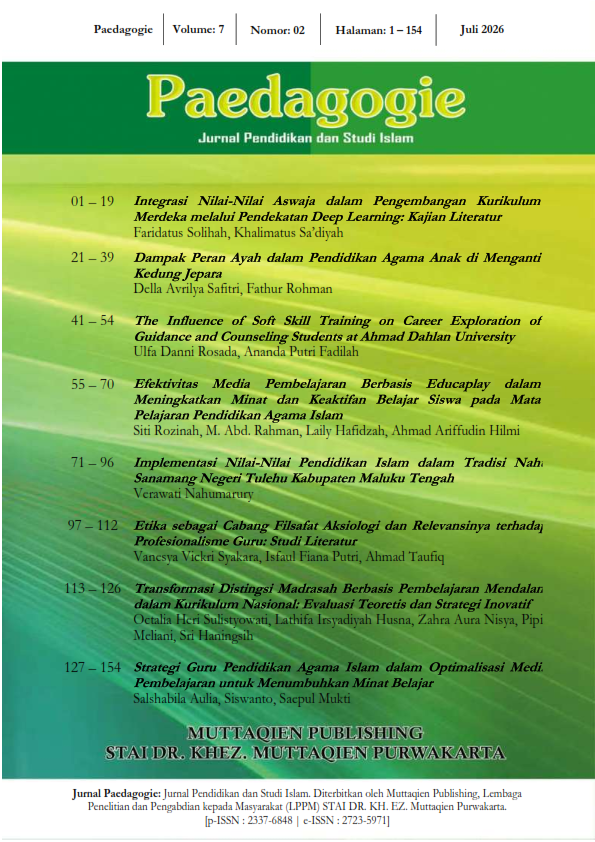
Etika sebagai Cabang Filsafat Aksiologi dan Relevansinya terhadap Profesionalisme Guru: Studi Literatur
Keywords:
Axiology, Ethics, Professional Ethics, Teacher Morality, Teacher ProfessionalismAbstract
The increasing complexity of moral challenges faced by teachers, including violations of professional ethics, misuse of social media, and ethical dilemmas in educational practice, highlights the importance of ethics as the moral foundation of the teaching profession. This study aims to analyze ethics as a branch of axiological philosophy and examine its relevance to strengthening teacher professionalism. This research employed a qualitative approach using a literature study method. The study analyzed from scholarly references, consisting of books, national and international journal articles, and official documents published between 2020 and 2026. The literature was selected based on relevance, credibility, accessibility of full-text publications, and topical suitability. Data were analyzed using content analysis and a descriptive-critical approach through data reduction, data presentation, interpretation, and conclusion drawing. The findings indicate that ethics constitutes one of the principal branches of axiology, focusing on values, moral responsibility, goodness, and propriety in human actions. Within the educational context, ethics serves as a normative foundation that guides teachers in making responsible professional decisions. Furthermore, ethics significantly contributes to strengthening teachers' integrity, honesty, accountability, moral commitment, and exemplary conduct as essential characteristics of professional educators. Therefore, this study recommends integrating ethical and philosophical education more systematically into teacher education programs and continuous professional development to enhance teacher professionalism and promote humane, dignified, and character-oriented education.
References
Abdussamad, Z. (2021). Metode Penelitian Kualitatif. CV. Syakir Media Press.
Ali, A. (2025). FILSAFAT ILMU: ONTOLOGI, EPISTIMOLOGI, DAN AKSIOLOGI. AQIDAH-TA : Jurnal Ilmu Aqidah, 9(1), 55–71.
Ardiansyah, Risnita, & Jailani, M. S. (2023). Teknik Pengumpulan Data Dan Instrumen Penelitian Ilmiah Pendidikan Pada Pendekatan Kualitatif dan Kuantitatif. IHSAN: Jurnal Pendidikan Islam, 1(2), 1–9.
Bahrum. (2013). ONTOLOGI, EPISTEMOLOGI DAN AKSIOLOGI. Sulasena, 8(2), 35–45.
Dzulfiqar, A. S., Choiriyah, L., Kamandhani, R. P., & Luqna, W. (2026). Penguatan Karakter Tanggung Jawab Murid dalam Pembelajaran PAI melalui Keteladanan Guru dan Pendekatan Konstruktivisme. Paedagogie, 21(1), 1023–1036. https://doi.org/10.31603/paedagogie.v21i1.16297
Harahap, Y. Y. (2025). Etika Profesi Dalam Praktik Keguruan. Inklusi : Jurnal Pendidikan Islam Dan Filsafat Yayasan Salmiah Education Global International ( YSEGI ), 1(2), 118–125. https://glonus.org/index.php/inklusi
Hasanah, H. (2016). Teknik-teknik observasi. At-Taqaddum, 8(1), 21–46. https://doi.org/10.21580/at.v8i1.1163
Hatuwe, I. N., & Hamidah. (2025). Hubungan antara Deontologi dan Akuntansi : Sebuah Tinjauan Sistematis tentang Etika dalam Skandal Audit. JMPIS: Jurnal Manajemen Pendidikan Dan Ilmu Sosial, 6(6), 5318–5330.
Iskandar, A. M., Masdar, M., Ismail, A., & Sriwahyuni. (2026). Etika Profesi Keguruan Idealitas Moral, Integritas, Akuntabilitas Publik. PT Cipta Digital Edukasi.
Jannah, J., Miranti, A., & Fajriyah, S. (2026). Dilema Etika Guru dalam Pengambilan Keputusan Pendidikan. Jejak Digital Jurnal Ilmiah Multidisiplin, 2(1), 2201–2210.
Mardhatillah, A. S., & Ahida, R. (2025). Kajian ontologi, epistemologi, dan aksiologi sebagai Fondasi Filsafat Ilmu dalam pengembangan ilmu pengetahuan kontemporer. Journal Of Education, Cultural and Politics, 5(3), 670–676.
Mayasari, A., Natsir, N. F., & Haryanti, E. (2022). Aksiologi Ilmu Pengetahuan dan Keislaman. JIIP-Jurnal Ilmiah Ilmu Pendidikan, 5(1), 218–225.
Musthan, Z. (2024). Konsep Profesi Pendidikan dan Etika Keguruan (Pertama). TAHTA MEDIA GROUP.
Ningsih, W., & Urbayatun, S. (2021). Etika Psikolog dalam Pengumpulan dan Penyampaian Hasil Pemeriksaan Psikologis ( Tinjauan Aksiologi ). Jurnal Filsafat Indonesia, 4(1), 53–58.
Nurdiansyah, L., Febrialdo, R., Hariyadi, A., Wirawan, A., & Munir, M. M. (2026). Aksiologi dalam Perkembangan Ilmu Pengetahuan dan Teknologi: Perspektif Etika, Moral, dan Islam dalam Membangun Peradaban Humanis. Jurnal Keilmuan Dan Keislaman, 5(2), 467–487. https://doi.org/10.23917/jkk.v5i2.1024
Qalbi, N., Syamsuddin, & Abrar, A. I. P. (2025). Etika Profesi Guru : Fondasi Moral dan Kode Etik dalam Pendidikan. Jurnal Cahaya Edukasi, 2(4), 45–49. https://doi.org/10.63863/jce.v2i4.140
Sahara, S. R., Riyadi, A. R., & Maulidah, N. (2025). Identitas Profesional Guru Sekolah Dasar Berdasarkan Pengalaman Mengajar : Tinjauan Filosofis , Teoritis dan Praktis. ELEMENTARY JOURNAL, 8(1), 136–150.
Sari, A. R. (2005). MORALITAS DAN PROFESIONALISME GURU DALAM KEPENDIDIKAN DI INDONESIA. JURNAL PENDIDIKAN AKUNTANSI INDONESIA, IV(1), 134–144.
Shalehoddin, Rasyida, N. A., & Ekowat, D. W. (2026). PROFESIONALISME GURU BERBASIS INTEGRITAS DAN KETELADANAN. Didaktik : Jurnal Ilmiah PGSD FKIP Universitas Mandir, 12(2), 226–237.
Susmita, N., Zaim, M., & Thahar, H. E. (2023). Tinjauan Filosofis : Membangun Landasan Etika dan Pengetahuan dalam Filsafat Pendidikan Kontemporer. Journal of Education Research, 4(4), 2461–2470. https://doi.org/10.37985/jer.v4i4.755
Suyitno, Haryanti, N., & Rafiqie, M. (2025). Etika Profesi Keguruan. EUREKA MEDIA AKSARA, APRIL 2025 ANGGOTA IKAPI JAWA TENGAH NO. 225/JTE/2021.
Tompul, V. B., Sari, A. R., Manullang, S. O., Kusmadevi, Y., & Ferdiansyah, H. (2022). Mengenal Etika Dan Etiket Pendidik Profesional Dalam Pendidikan Karakter di Indonesia Verawati. Jurnal Pendidikan Dan Konseling, 4(5), 7191–7199.
Wahidah, S. H., Arianti, D., & Yahya, M. (2025). Etika Profesi Sebagai Landasan Moral Guru Dan Tenaga Kependidikan. Quantum Edukatif: Jurnal Pendidikan Multidisiplin, 02(02), 60–66. https://synergizejournal.org/index.php/QE
Waris, A., & Yusuf, K. (2026). Profesionalisme Pendidik Bahasa Arab dalam Perspektif Filsafat Etika : Implikasinya terhadap Pengembangan Kopetensi Guru. Kampus Akademik Publishing: Jurnal Ilmiah Nusantara (JINU), 3(1), 1026–1041. https://doi.org/10.61722/jinu.v3i1.7854
Yorman, Djollong, A. F., Setiyadi, M. W., Mahmudi, M. A., Harsa, H., Saleh, Haryani, Rodin, R., Atikah, C., Adika, D., Charles, & Purnomo, E. (2023). Etika Profesi Guru. PT. Mifandi Mandiri Digital Redaksi.
Published
How to Cite
Issue
Section
Copyright (c) 2026 Vanesya Vickri Syakara, Isfaul Fiana Putri, Ahmad Taufiq

This work is licensed under a Creative Commons Attribution-ShareAlike 4.0 International License.
Copyright and Licensing Policy
Paedagogie: Jurnal Pendidikan dan Studi Islam allows authors to retain the copyright of their work and to retain publishing rights. By submitting and publishing with this journal, authors agree to the following terms:
-
Copyright remains with the author(s), and they grant the journal the right of first publication. The work is published under a Creative Commons Attribution-ShareAlike 4.0 International License (CC BY-SA 4.0), which permits use, distribution, and reproduction in any medium, provided the original work is properly cited and any derivative works are distributed under the same license.
-
Authors are allowed to enter into additional non-exclusive distribution agreements (e.g., posting to institutional repositories, publishing in books), with acknowledgment of the work's initial publication in this journal.
-
Authors are encouraged to disseminate their work online (e.g., in repositories or on personal websites) before and during the submission process to increase visibility and impact.
Paedagogie: Jurnal Pendidikan dan Studi Islam supports open access and affirms that libre access with a CC BY-SA license or its equivalent is the optimal approach for scholarly communication. We prioritize free and open dissemination while encouraging the reuse and adaptation of published content under fair and equitable terms.

You are free to:
- Share — copy and redistribute the material in any medium or format
- Adapt — remix, transform, and build upon the material for any purpose, even commercially.
- The licensor cannot revoke these freedoms as long as you follow the license terms.