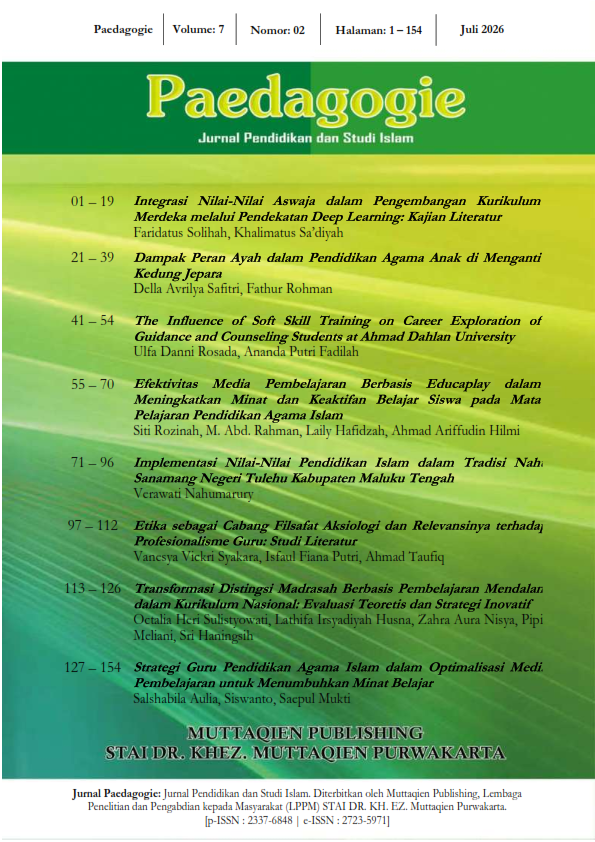
Strategi Guru Pendidikan Agama Islam dalam Optimalisasi Media Pembelajaran untuk Menumbuhkan Minat Belajar
Keywords:
Elementary School, Instructional Media, Islamic Education Teachers, Learning InterestAbstract
The use of instructional media is an essential factor in creating engaging learning experiences and fostering students' interest in learning. However, the use of instructional media in Islamic Religious Education (IRE) remains suboptimal due to limitations in school facilities and teachers' competencies in utilizing instructional media effectively. This study aimed to describe the availability of instructional media, the strategies employed by IRE teachers in utilizing instructional media, and the challenges encountered in its implementation at SDN Sawah Kulon. This study adopted a qualitative approach with a descriptive design. The participants consisted of one IRE teacher, one vice principal, and several students selected through purposive sampling. Data were collected through observations, interviews, and documentation and analyzed using the Miles and Huberman interactive model, including data condensation, data display, and conclusion drawing. The findings revealed that instructional media at SDN Sawah Kulon were relatively adequate and were utilized through visual, audiovisual, and technology-based media according to the characteristics of the learning materials. Their use created more varied learning experiences, enhancing students' attention, interest, and active participation. The main challenges included limited internet access, inadequate supporting facilities, and teachers' competencies in optimizing instructional media. The study concludes that effective utilization of instructional media, supported by adequate facilities and teacher competence, contributes to more engaging learning and promotes students' interest in learning. These findings imply the need to strengthen teachers' competencies and improve school facilities to support more effective, innovative, and student-centered Islamic Religious Education.
References
Aimang, T. H. (2023). Pengaruh Pemanfaatan Media Augmented Reality Dalam Meningkatkan Minat Belajar Siswa Kelas Iv. 01, 1–23.
Akbar, S., Salminawati, S., & Rakhmawati, F. (2022). Pengembangan Media Pembelajaran Biologi Untuk Meningkatkan Minat Belajar Siswa. Jurnal EDUCATIO (Jurnal Pendidikan Indonesia), 11(2), 733–743. https://doi.org/10.55129/jp.v11i2.1627
Angkilang, Dahlan, M., Risaldi, A., & Azzahra, S. (2026). Pemanfaatan Media Pembelajaran dalam Meningkatkan Keterampilan Belajar Siswa. Jurnal Ilmiah FKIP Universitas Mandiri, 12, 245–259. https://journal.stkipsubang.ac.id/index.php/didaktik/article/view/14407/8722
Arif, M. N., Parawansyah, M. I., Huda, F. H., & Zulfahmi, M. N. (2025). Strategi menumbuhkan Minat Belajar Siswa Melalui Pendekatan Deep Learning. Jurnal Muassis Pendidikan Dasar, 4(1), 8–16.
Arifannisa, Yuliasih, M., Hayati, Sepriano, Adnyana, I. N. W., Putra, P. S. U., & Pongpalilu, F. (2023). Sumber dan Pengembangan Media Pembelajaran (Teori dan Penerapan) (Efitra, Ed.). PT. Sonpedia Publishing Indonesia. https://books.google.co.id/books/about/SUMBER_PENGEMBANGAN_MEDIA_PEMBELAJARAN_T.html?id=oV63EAAAQBAJ&redir_esc=y
Falahudin, I. (2014). Pemanfaatan Media dalam Pembelajaran. Jurnal Lingkar Widdyaiswara, 4(2), 104–117. https://lmsspada.kemdiktisaintek.go.id/pluginfile.php/98908/mod_resource/content/7/Pemanfaatan Media dalam Pembelajaran.pdf
Febriana, R., Emra, R. R. R., Reza, W., Fitria, Y., & Media, A. (2024). Pentingnya Media Pembelajaran dalam Proses Pembelajaran Guna Meningkatkan Hasil Belajar. Jurnal Pendidikan Tambusai, 8(3), 44494–44498. https://jptam.org/index.php/jptam/article/view/21072
Haq, N. I., Supendi, D., & Mukti, S. (2025). Pengaruh Metode Problem Solving dalam Meningkatkan Berpikir Kritis Peserta Didik pada Mata Pelajaran PAI. 2(September).
Hidayah, N. C., Fajriyah, K., & Kartinah. (2023). Aalisis Minat Belajar Siswa Melalui Media Gambar Siswa Kelas 2 SDN Sawah Besar 01 Noer. Jurnal Ilmiah PGSD FKIP Universitas Mandiri, 09, 3966-.
Imanulhaq, R., & Ichsan. (2022). Analisis Teori Perkembangan Kognitif Piaget Pada Tahap Anak Usia Operasional Konkret 7-12 Tahun Sebagai Dasar Kebutuhan Media Pembelajaran. Waniambey: Journal of Islamic Education, 3(2), 126–134. https://doi.org/10.53837/waniambey.v3i2.174
Miftah, M., & Nur Rokhman. (2022). Kriteria pemilihan dan prinsip pemanfaatan media pembelajaran berbasis TIK sesuai kebutuhan peserta didik. Educenter : Jurnal Ilmiah Pendidikan, 1(9), 641–649. https://doi.org/10.55904/educenter.v1i9.92
Moleong. (2016). Metodologi Penelitian Kualitatif.
Mujahidah, A., & Ayni, N. S. (2024). Pengaruh Penggunaan Media Pembelajaran Aplikasi Canva Terhadap Minat Belajar PAI Siswa. JIKAP PGSD: Jurnal Ilmiah IlmuKependidikan, Vol, 8. No(e-ISSN: 2597-4440 dan p-ISSN: 2597-4424), 429–435.
Mulyadi, D. (2026). Hasil wawancara mendalam.
Mutia. (2021). Characteristcs Of Children Age Of Basic Education. 3, 114–131.
Pagarra, H., Syawaluddin, A., Krismanto, W., & Sayidiman. (2022). Media Pembelajaran. In Badan Penerbit UNM.
Parhan, & Safii, M. (2023). Hubungan Sistem Pembelajaran Daring Dengan Minat Belajar Bahasa Arab Siswa. Ta’limi : Journal of Arabic Education & Arabic Studirs, 2(1), 1–15.
Perdanasari, A. (2020). Media Pembelajaran Berbasis TIK (MembaTIK) dengan Fluvid untuk meningkatkan hasil belajar mata pelajaran PKWu. https://journal.uny.ac.id/index.php/jppfa/article/view/35842
Putri, D. J., Angelina, S., Rahma, S. C., & Mujazi, M. (2022). Faktor-faktor yang mempengaruhi minat belajar siswa di kecamatan Larangan Tangerang. Seminar Nasional Ilmu Pendidikan Dan Multi Disiplin, 5(1), 49–53.
Ricardo, & Meilani, R. I. (2017). Impak Minat dan Motivasi Belajar Terhadap Hasil Belajar Siswa. Jurnal Pendidikan Manajemen Perkantoran, 2(2), 188–201. https://doi.org/10.17509/jpm.v2i2.8108
Septianti, N., & Afiani, R. (2020). Pentingnya Memahami Karakteristik Siswa Sekolah Dasar di SDN Cikokol 2. 2, 7–17.
Siburian, A., Siahaan, E. A., & Naibaho, D. (2023). Kreatifitas Guru dalam Meningkatkan Minat Belajar Siswa. 2(2), 11202–11209. https://publisherqu.com/index.php/pediaqu
Simorangkir, A. (2023). Determinan Minat Belajar Siswa Melalui Kompetensi Profesional Guru. Jurnal Pendidikan, 2(4), 13012–13018. https://publisherqu.com/index.php/pediaqu
Sufiani, & Putra, A. T. A. (2023). Strategi Guru PAI dalam Meningkatkan Minat Belajar Siswa Mata Pelajaran PAI di SD Negeri 21 Kendari. Journal of Elementary Educational Research, 3(1), 55–66. http://ejournal.iain-manado.ac.id/index.php/jeer
Susanti, Y. (2020). Pembelajaran Matematika dengan Menggunakan Media Berhitung di Sekolah Dasar untuk Meningkatkan Pemahaman Siswa. Jurnal Edukasi Dan Sains, 2(3), 435–448. https://ejournal.stitpn.ac.id/index.php/edisi/article/view/1122
Sutisna, E. (2026). Hasil Wawancara mendalam.
Tafonao, T. (2018). Peranan Media Pembelajaran Dalam Meningkatkan Minat Belajar Mahasiswa. Jurnal Komunikasi Pendidikan, 2(2), 103. https://doi.org/10.32585/jkp.v2i2.113
Wininggar, I. A., Fitriana, S., & Lestar, F. W. (2025). Analisis Faktor-Faktor yang Mempengaruhi Minat Belajar Siswa Kelas IX-A di SMPN 01 Paninggaran. Risâlah Jurnal Pendidikan Dan Studi Islam, 11(4), 1501–1510. https://doi.org/10.31943/jurnal_risalah.v11i4.2739.%0AAbstract:
Yunizar, H. V., Karina, S., & Gusmaneli. (2024). Membangun Karakter Bangsa: Peran Pendidikan dalam Membentuk Generasi Unggul. Jurnal Ilmu Manajemen Dan Pendidikan, 01(03), 18–20.
Published
How to Cite
Issue
Section
Copyright (c) 2026 Salshabila Aulia, Siswanto Siswanto, Saepul Mukti

This work is licensed under a Creative Commons Attribution-ShareAlike 4.0 International License.
Copyright and Licensing Policy
Paedagogie: Jurnal Pendidikan dan Studi Islam allows authors to retain the copyright of their work and to retain publishing rights. By submitting and publishing with this journal, authors agree to the following terms:
-
Copyright remains with the author(s), and they grant the journal the right of first publication. The work is published under a Creative Commons Attribution-ShareAlike 4.0 International License (CC BY-SA 4.0), which permits use, distribution, and reproduction in any medium, provided the original work is properly cited and any derivative works are distributed under the same license.
-
Authors are allowed to enter into additional non-exclusive distribution agreements (e.g., posting to institutional repositories, publishing in books), with acknowledgment of the work's initial publication in this journal.
-
Authors are encouraged to disseminate their work online (e.g., in repositories or on personal websites) before and during the submission process to increase visibility and impact.
Paedagogie: Jurnal Pendidikan dan Studi Islam supports open access and affirms that libre access with a CC BY-SA license or its equivalent is the optimal approach for scholarly communication. We prioritize free and open dissemination while encouraging the reuse and adaptation of published content under fair and equitable terms.

You are free to:
- Share — copy and redistribute the material in any medium or format
- Adapt — remix, transform, and build upon the material for any purpose, even commercially.
- The licensor cannot revoke these freedoms as long as you follow the license terms.