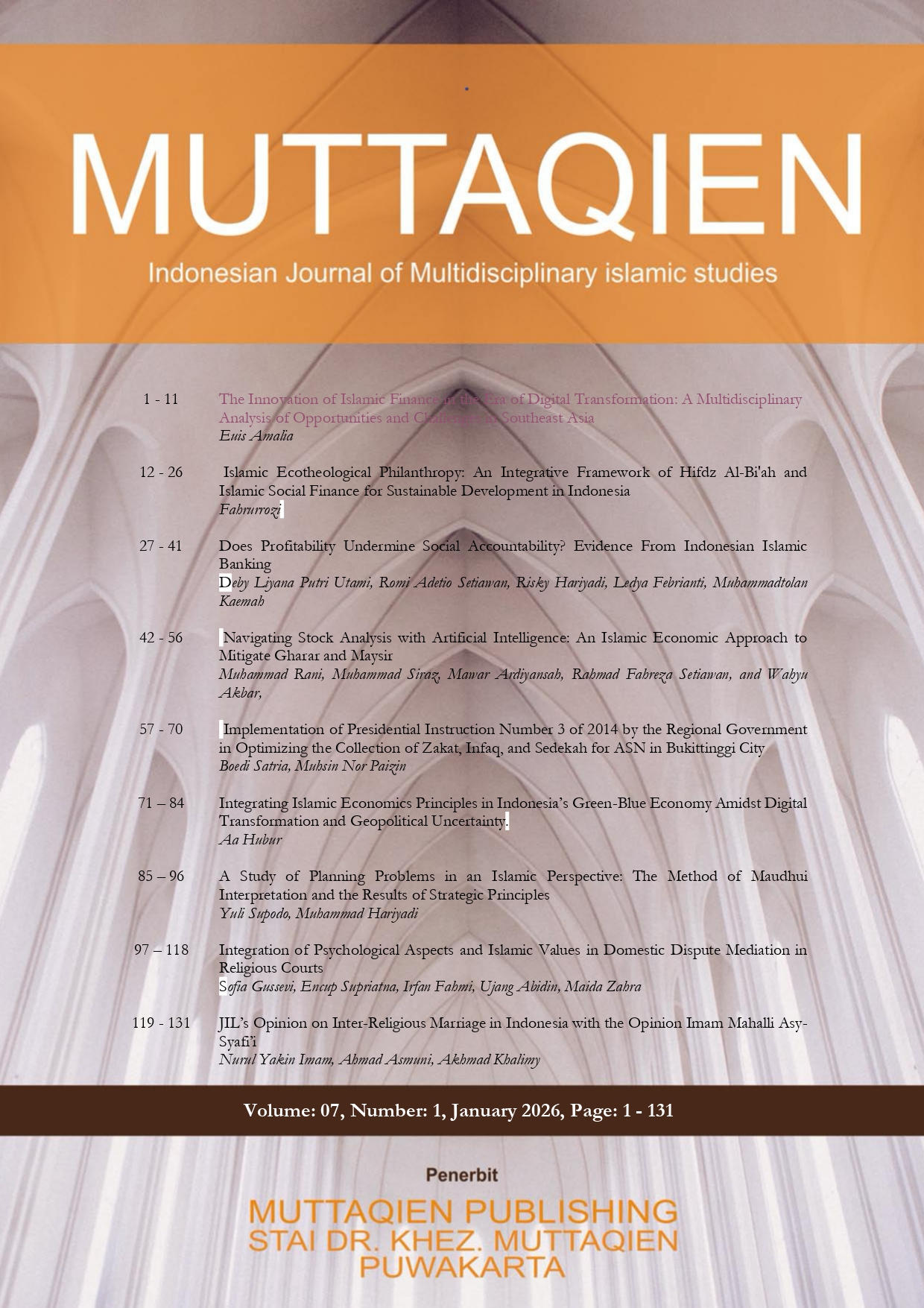
JIL’s Opinion on Inter-Religious Marriage in Indonesia with the Opinion of Imam Mahalli Asy-Syafi’i
Keywords:
JIL Band, Marriage by Religion , Local ImamAbstract
Marriage is a fundamental subject in Islamic jurisprudence (fiqh) because it is the primary foundation of the family structure and Muslim society. In the modern era, rapid technological and media advancements have expanded the boundaries of social interaction and sparked various moral challenges. A crucial issue currently generating debate in Indonesia is the phenomenon of interfaith marriage between Muslims and non-Muslims. This matter has become increasingly concerning as some parties openly assert that interfaith marriages are unconditionally valid. In response to this controversy, this study aims to analyze the complexities of interfaith marriage in Indonesia and to formulate a clear, defensible legal position aligned with Sharia. This study employs a library research methodology with a normative legal approach, drawing upon the Qur'an, Hadith, and scholarly fatwas, while focusing specifically on the arguments presented in the text Kanz al-Raghib. The findings indicate that, according to this text, marriage between a Muslim and a *hl al-Kitab* (People of the Book) is fundamentally valid but subject to very strict conditions. Failure to meet any of these conditions renders the marriage void or invalid. This study contributes to educating the Muslim community in Indonesia and establishing legal clarity, while also providing an academic response to erroneous views that seek to unconditionally legitimize interfaith marriage without regard for the principles of Islamic jurisprudence.
References
محمد حرسونوا (2023) أراء فرقة جيل على الزواج باختلاف الدين، الأحوال vol:2 ، 5-8.
السجستاني، أبو داود سليمان بن الأشعث. سنن أبي داود.ج:3. تحقيق: محمد محي الدين عبد الحميد. بيروت:لبنان.المكتبة العصرية. ص:119.
القزويني، أبو عبد الله محمد بن يزيد بن ابن ماجه. سنن ابن ماجه.ج:1.تحقيق: محمد فؤاد عبد الباقي. دار إحياء الكتب العربية. ص: 21.
الرازي، أبو محمّد عبد الرّحمن بن محمّد بن إدريس التميمي الحنظلي. (1424 ه/ 2003 م). آداب الشاّفعي ومناقبه. ط:1. تحقيق: عبد الغني عبد الخالق. بيروت: لبنان. دار الكتب العلمية. ص:244.
الشيرازي، الحسين بن محمود. (1433 ه/ 2012 م). المفاتيح في شرح المصابيح.ج:1. تحقيق: لجنة مختصة من المحققين بإشراف: نور الدّين طالب. كويت. دار النوادر-وزارة الأوقاف الكويتية. ط:1. ص:334.
جلال الدّين أبي عبيد الله محمد بن أحمد المحلي الشافعي. بدر الطالع في حلّ جمع الجوامع. ج:1. بيروت:لبنان. مؤسسة الرسالة ناشرون. ط.1. ص: 83.
الحصني .تقي الدين .كفاية الأخيار .[2008]. تحقيق :محمد مسعد ومحمد رمضان .القاهرة .مصر .المكتبة التوفقية .ط:2 ص:465.
الزهيلي، وهبة بن مصطفى. (2012). الفقه الإسلامي وأدلته. ج:9. دمشق: سورية. دار الفكر. ط: 3. ص:513.
حسين محمد، خيار الأحبة و طريقة الخطبة في الإسلام، (جاكرتا، مكتبة gema insani، 2001)، ص: 26-29. حسين محمد، خيار الأحبة و طريقة الخطبة في الإسلام، (جاكرتا، مكتبة gema insani، 2001)، ص: 26-29.
جلال الدين محمد بن أحمد بن محمد المحلي، كنز الراغبين شرح منهاج الطالبين، ج:2. (مركز دار المنهاج 1434ه.) ص: 240.
البخاري الجعفي، الجامع المسند الصحيح المختصر من أمور رسول الله صلى الله عليه وسلم وسننه وأيامه. دار طوق النجاة ط:1. ج: 1. ص: 26. رقم: 143.
شمس الدين أبي عبد الله محمد بن قاسم بن محمد الغرابيلي الشافعي، فتح القريب المجيب، (دار المنهاج) ص: 194.
Published
How to Cite
Issue
Section
Copyright (c) 2026 Nurul Yakin Imam, Ahmad Asmuni, Akhmad Khalimy

This work is licensed under a Creative Commons Attribution-ShareAlike 4.0 International License.
Muttaqien; Indonesian Journal of Multidiciplinary Islamic Studies allows the author(s) to hold the copyright without restrictions and allows the author(s) to retain publishing rights without restrictions, and authors who publish with this journal agree to the following terms:
In developing strategy and setting priorities, Muttaqien; Indonesian Journal of Multidiciplinary Islamic Studies recognize that free access is better than priced access, libre access is better than free access, and libre under CC-BY-SA or the equivalent is better than libre under more restrictive open licenses. We should achieve what we can when we can. We should not delay achieving free in order to achieve libre, and we should not stop with free when we can achieve libre.
Muttaqien; Indonesian Journal of Multidiciplinary Islamic Studies has a CC-BY SA license or its equivalent as the optimal license for publication, distribution, use and reuse of scientific work. This license is under a Creative Commons Attribution 4.0 International License.

You are free to:
- Share copy and redistribute the material in any medium or format
- Adapt remix, transform, and build upon the material for any purpose, even commercially.
- The licensor cannot revoke these freedoms as long as you follow the license terms.