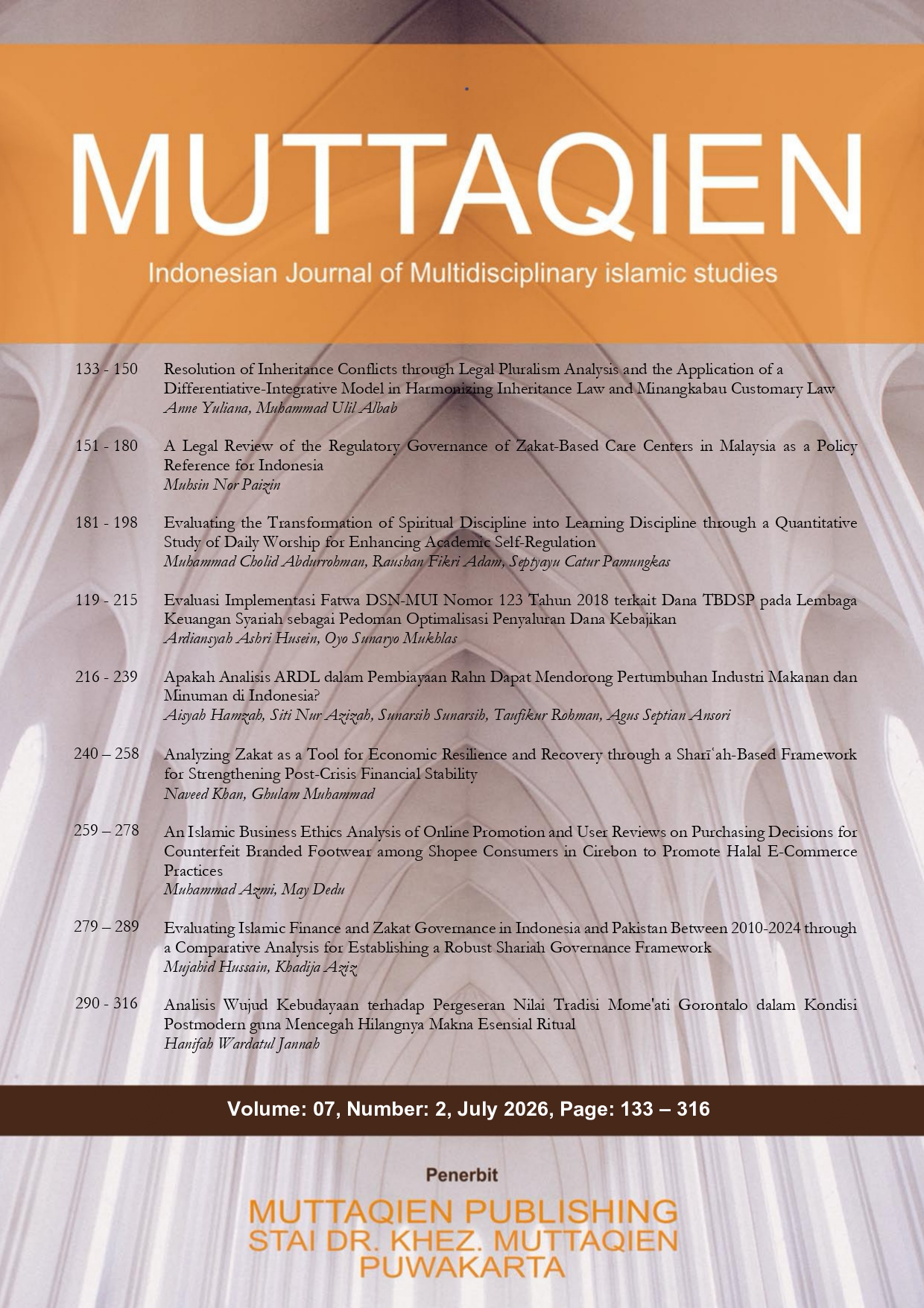
Evaluating the Transformation of Spiritual Discipline into Learning Discipline through a Quantitative Study of Daily Worship for Enhancing Academic Self-Regulation
Keywords:
Academic self-regulation, worship habits, Islamic education, delayed gratification, self-regulated learningAbstract
Daily religious practice theoretically fosters executive functions and cognitive control, yet empirical evidence regarding its impact on learning management remains limited. This study aims to investigate the influence of daily religious habits on students' academic self-regulation. Employing a quantitative method, the study involved a sample of 187 secondary school students. Data were collected using a validated Likert-scale self-report questionnaire. The primary analysis utilized a simple linear regression test, subsequently validated through a robustness check using Spearman's Rho non-parametric correlation. Empirical results reveal a positive and significant relationship between daily religious habits and academic self-regulation (ρ< .01). The resulting regression equation is Y=3.911+ 0.750X, with a coefficient of determination (R2) of .356. These findings confirm that the intensity of religious practice contributes 35.6% to students' learning autonomy. The robustness check consistently validated the model (rs=0.541). Spiritual practices appear to activate mechanisms, such as delayed gratification and religious coping, that mitigate academic procrastination. In conclusion, this study provides an empirical foundation for educational transformation; religious routines in schools should no longer be viewed merely as moral tools but as a rational infrastructure that translates spiritual discipline into academic discipline. Educational institutions are encouraged to redesign classroom instruction by strategically integrating religious habits to cultivate autonomous learners with robust self-regulation capabilities.References
Asosiasi Penyelenggara Jasa Internet Indonesia (APJII). (2024, February 7). Jumlah pengguna internet Indonesia tembus 221 juta orang. https://apjii.or.id/berita/d/apjii-jumlah-pengguna-internet-indonesia-tembus-221-juta-orang
Boateng, G. O., Neilands, T. B., Frongillo, E. A., Melgar-Quiñonez, H. R., & Young, S. L. (2018). Best Practices for Developing and Validating Scales for Health, Social, and Behavioral Research: A Primer. Frontiers in Public Health, 6, 149. https://doi.org/10.3389/fpubh.2018.00149
Chakraborty, R., & Chechi, V. K. (2026). Academic Delay of Gratification: Self‐Regulated Learning Research Among Undergraduate Indian Students. New Directions for Teaching and Learning, 2026(185), 65–69. https://doi.org/10.1002/tl.70008
Creswell, J. W. (2014). Research design: Qualitative, quantitative, and mixed methods approaches (4. ed). SAGE.
David, P., Kim, J.-H., Brickman, J. S., Ran, W., & Curtis, C. M. (2015). Mobile phone distraction while studying. New Media & Society, 17(10), 1661–1679. https://doi.org/10.1177/1461444814531692
Effendi, M. R., Nur Aulia, R., Amaliyah, A., & Fathiya Salsabila, N. (2023). Integrasi Pendidikan Islam Berbasis Ilmu Sosial Profetik dalam Penguatan Keberagamaan Mahasiswa. Muttaqien; Indonesian Journal of Multidiciplinary Islamic Studies, 4(2), 161–176. https://doi.org/10.52593/mtq.04.2.06
Guo, L. (2022). The effects of self-monitoring on strategy use and academic performance: A meta-analysis. International Journal of Educational Research, 112, 101939. https://doi.org/10.1016/j.ijer.2022.101939
Hamilaturroyya, H., & Adibah, I. Z. (2025). Dinamika Pengembangan Kurikulum di Era Digital dalam Menjawab Kesenjangan Konsep dan Praktik. LEARNING : Jurnal Inovasi Penelitian Pendidikan Dan Pembelajaran, 5(3), 1245–1259. https://doi.org/10.51878/learning.v5i3.6631
Hasyim, M., & Najibah, A. (2022). Pembentukan Karakter Religius Siswa berbasis Pembiasaan dalam Kegiatan Ekstrakurikuler di Madrasah. Journal of Education and Religious Studies, 2(02), 53–61. https://doi.org/10.57060/jers.v2i02.62
Jaya, A. C., Hajaroh, M., & Eliasa, E. I. (2025). The Influence of Self-Regulation and Time Management on Student Academic Procrastination. Jurnal Ilmiah Bimbingan Konseling Undiksha, 16(2), 114–124. https://doi.org/10.23887/jibk.v16i2.93881
Kurnia, M. K. S., Edi Suresman, Jenuri, & Zaman, A. R. B. (2024). The Impact of Quran Recitation Habits Before Class on Students’ Mental Readiness for Learning. Journal of Islamic Education Research, 5(3). https://doi.org/10.35719/jier.v5i3.441
Kwak, S. G., & Kim, J. H. (2017). Central limit theorem: The cornerstone of modern statistics. Korean Journal of Anesthesiology, 70(2), 144. https://doi.org/10.4097/kjae.2017.70.2.144
Mahrufah, M., & Rijanto, T. (2024). Pengaruh Self-Regulated Learning Terhadap Kemampuan Berpikir Kritis dan Hasil Belajar Siswa. Jurnal Pendidikan Madrasah, 9(2), 213–218. https://doi.org/10.14421/jpm.2024.213-218
Mao, G. (2017). Robust test for independence in high dimensions. Communications in Statistics - Theory and Methods, 46(20), 10036–10050. https://doi.org/10.1080/03610926.2016.1228965
Munawaroh, M., Alhadi, S., & Saputra, W. (2017). Tingkat Prokrastinasi Akademik Siswa Sekolah Menengah Pertama Muhammadiyah 9 Yogyakarta. Jurnal Kajian Bimbingan Dan Konseling, 2(1), 26–31. https://doi.org/10.17977/um001v2i12017p026
Ningsih, R. A., & Lessy, Z. (2024). Moulding Discipline Character In Daily Activities Of Students At an Nur Islamic Boarding School Ngrukem Bantul. International Journal of Sociology of Religion, 1(2), 216–231. https://doi.org/10.70687/ijsr.v1i1.17
Organisation for Economic Co-operation and Development (OECD). (2023). PISA 2022 results—Country note: Indonesia. OECD Publishing. https://www.oecd.org/en/publications/pisa-2022-results-volume-i-and-ii-country-notes_ed6fbcc5-en/indonesia_c2e1ae0e-en.html
Organisation for Economic Co-operation and Development (OECD). (2024). Managing screen time: How to protect and equip students in a digital world (PISA in Focus No. 124). OECD Publishing. https://doi.org/10.1787/7c225af4-en
Panadero, E. (2017). A review of self-regulated learning: Six models and four directions for research. Frontiers in Psychology, 8, 422. https://doi.org/10.3389/fpsyg.2017.00422
Rindfleisch, A., Malter, A. J., Ganesan, S., & Moorman, C. (2008). Cross-Sectional versus Longitudinal Survey Research: Concepts, Findings, and Guidelines. Journal of Marketing Research, 45(3), 261–279. https://doi.org/10.1509/jmkr.45.3.261
Sarijanah, H., Islamy, F. J., & Meilani, R. I. (2025). Regulasi Diri dan Prokrastinasi Akademik: Studi Kuantitatif di Kalangan Siswa SMK. Jurnal Pendidikan Manajemen Perkantoran, 10(2), 187–200. https://doi.org/10.17509/jpm.v10i2.74583
Suan, A. F. (2023). Self–Regulation as an Antecedent of Academic Achievement: A Mixed Method Study. British Journal of Multidisciplinary and Advanced Studies, 4(4), 20–43. https://doi.org/10.37745/bjmas.2022.0246
Sumia, D., Sandayanti, V., & Detty, A. U. (2020). Pengaruh Teman Sebaya dan Regulasi Diri dalam Belajar pada Mahasiswa. Jurnal Psikologi Malahayati, 2(2). https://doi.org/10.33024/jpm.v2i2.2593
Susanto, F. A., Padil, Moh., Yasin, A. F., Syarifaturrahmatullah, S., Rifai, A. S., Hamzah, I., Bunayar, B., & Asy’arie, B. F. (2025). Educational Management in Islamic Boarding Schools: Enhancing Students’ Religious Character in Indonesian Senior High Schools. AL-ISHLAH: Jurnal Pendidikan, 17(3). https://doi.org/10.35445/alishlah.v17i3.7405
Waheed, Z., Tham, Dr. J., & Keat, Dr. O. B. (2025). The Impact of Self-Regulated Learning Strategies on Academic Performance: A Systematic Review. Social Science and Human Research Bulletin, 02(08). https://doi.org/10.55677/SSHRB/2025-3050-0803
Yazidsyah, R., & Harahap, A. C. P. (2023). Hubungan Antara Situasi Akademik Dengan Self-Regulated Learning Pada Mahasiswa Bimbingan Konseling Pendidikan Islam. JURNAL BIMBINGAN DAN KONSELING AR-RAHMAN, 9(1), 91. https://doi.org/10.31602/jbkr.v9i1.11583
Yufarika, S. D. (2023). Tantangan Dunia Pendidikan Dan Implikasinya Terhadap Perubahan Kebijakan. Ar-Rosikhun: Jurnal Manajemen Pendidikan Islam, 2(2), 156–161. https://doi.org/10.18860/rosikhun.v2i2.21812
Yuniarto, T. (2022, June 4). Nomophobia dan Belenggu Digital Generasi Indonesia. Kompaspedia. https://kompaspedia.kompas.id/baca/paparan-topik/nomophobia-dan-belenggu-digital-generasi-indonesia?track_source=kompaspedia-paywall&track_medium=login-paywall&track_content=https://kompaspedia.kompas.id/baca/paparan-topik/nomophobia-dan-belenggu-digital-generasi-indonesia
Zimmerman, B. J. (2002). Becoming a self-regulated learner: An overview. Theory Into Practice, 41(2), 64–70. https://doi.org/10.1207/s15430421tip4102_2
Published
How to Cite
Issue
Section
Copyright (c) 2026 Muhammad Cholid Abdurrohman, Raushan Fikri Adam, Septyayu Catur Pamungkas

This work is licensed under a Creative Commons Attribution-ShareAlike 4.0 International License.
Muttaqien; Indonesian Journal of Multidiciplinary Islamic Studies allows the author(s) to hold the copyright without restrictions and allows the author(s) to retain publishing rights without restrictions, and authors who publish with this journal agree to the following terms:
In developing strategy and setting priorities, Muttaqien; Indonesian Journal of Multidiciplinary Islamic Studies recognize that free access is better than priced access, libre access is better than free access, and libre under CC-BY-SA or the equivalent is better than libre under more restrictive open licenses. We should achieve what we can when we can. We should not delay achieving free in order to achieve libre, and we should not stop with free when we can achieve libre.
Muttaqien; Indonesian Journal of Multidiciplinary Islamic Studies has a CC-BY SA license or its equivalent as the optimal license for publication, distribution, use and reuse of scientific work. This license is under a Creative Commons Attribution 4.0 International License.

You are free to:
- Share copy and redistribute the material in any medium or format
- Adapt remix, transform, and build upon the material for any purpose, even commercially.
- The licensor cannot revoke these freedoms as long as you follow the license terms.