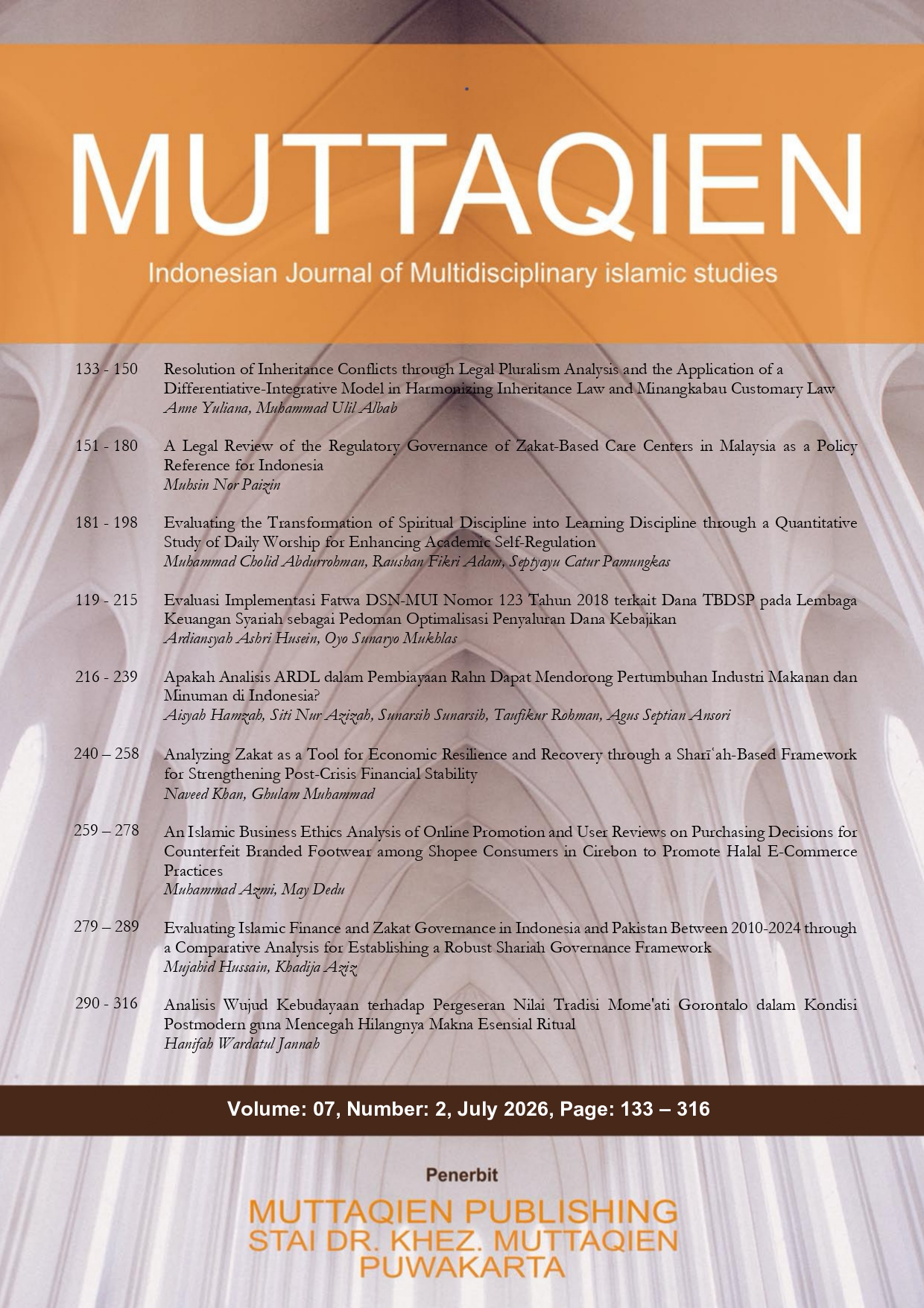
Evaluasi Implementasi Fatwa DSN-MUI Nomor 123 Tahun 2018 terkait Dana TBDSP pada Lembaga Keuangan Syariah sebagai Pedoman Optimalisasi Penyaluran Dana Kebajikan
Keywords:
TBDSP Funds, DSN-MUI Fatwa, Islamic Financial Institutions, Sharia Compliance, AccountabilityAbstract
DSN-MUI Fatwa Number 123/DSN-MUI/XI/2018 provides essential guidelines regarding the use of Funds Not Recognized as Income (TBDSP) within Sharia Financial Institutions (LKS). This fatwa was issued in response to operational practices that generate funds from non-Sharia transactions, such as correspondent bank interest and late payment penalties (ta'widh and gharamah). This study aims to analyze the implementation of the fatwa in Indonesia to optimize the distribution of benevolent funds (dana kebajikan). It employs a normative-juridical method utilizing statutory, conceptual, and fatwa-based approaches. The findings indicate that most Sharia banks have implemented the segregation of TBDSP funds from operational income for distribution toward social activities. However, implementation faces challenges regarding inconsistent accounting standards, reporting transparency, and Sharia oversight. As a novel contribution, this study asserts that optimizing TBDSP funds as benevolent funds has significant implications for educational transformation. If strategically allocated to the education sector, these funds can serve as a pillar of alternative financing to enhance academic infrastructure and the quality of human resources. Therefore, it is necessary to strengthen regulations, enhance the role of the Sharia Supervisory Board (DPS), and harmonize rules to ensure that fund distribution adheres to the principles of maqāṣid al-syarī‘ah, transparency, and accountability.References
AAOIFI, Governance Standard for Islamic Financial Institutions, No. 1: Sharia Supervisory Board: Appointment, Composition and Report, Manama: AAOIFI, 2024
Abu Ishaq al-Shatibi, Al-Muwafaqat fi Usul al-Shari'ah, Juz II, Beirut: Dar al-Kutub al-'Ilmiyyah, 2004.
Achmad Nursobah dan Muhajir, Nalar Ḥikmah dalam Fatwa Dsn-Mui tentang Penggunaan Dana Tidak Boleh Diakui sebagai Pendapatan (TBDSP) bagi Lembaga Keuangan Syariah, JIEI: Jurnal Ilmiah Ekonomi Islam, Vol. 11No. 3 (2025): 98-112
Adiwarman A. Karim, Bank Islam: Analisis Fiqh dan Keuangan, Edisi Keenam Depok: RajaGrafindo Persada, 2019
Dewan Syariah Nasional–Majelis Ulama Indonesia, Fatwa DSN-MUI No.123/DSN-MUI/XI/2018 tentang Penggunaan Dana yang Tidak Boleh Diakui sebagai Pendapatan bagi Lembaga Keuangan Syariah, Lembaga Bisnis Syariah dan Lembaga Perekonomian Syariah, Jakarta: DSN-MUI, 2018.
Diana Restu Cahyani dan M. Lathoif Ghozali, “Analisis Fatwa DSN-MUI No. 123/DSN-MUI/XI/2018 terhadap Penggunaan Dana TBDSP di BTPN Syariah Periode 2020–2023,” Journal of Economic, Business and Accounting (COSTING) 7, no. 5 (2024): 4241–4248;
Fatwa DSN-123-DSNMUI-XI-2018-2018 Tentang Penggunaan Dana Yang Tidak Boleh Diakui Sebagai Pendapatan Bagi Lembaga Keuangan Syariah, Lembaga Bisnis Syariah Dan Lembaga Perekonomian Syariah
Ikatan Akuntan Indonesia, Pernyataan Standar Akuntansi Keuangan (PSAK) Syariah, Jakarta: IAI, 2024
Jasser Auda, Maqasid Al-Shariah as Philosophy of Islamic Law: A Systems Approach, London: IIIT, 2008.
Maulani Salsabila dan Jajang Saepul Hamzah, "Management of Funds Not to Be Recognized as Income (TBDSP) in Islamic Financial Institutions, Businesses, and the Economy Based on Fatwa DSN-MUI," Mabahits Al-Uqud 2, no. 1 (2025): 67–79.
Muhammad Syafi'i Antonio, Bank Syariah dari Teori ke Praktik, Jakarta: Gema Insani, 2001.
Muhammad Taqi Usmani, An Introduction to Islamic Finance, (Karachi: Idaratul Ma'arif, 2002.
Otoritas Jasa Keuangan, Peraturan OJK Nomor 16/POJK.03/2022 tentang Bank Umum Syariah, khususnya ketentuan mengenai tata kelola dan fungsi Dewan Pengawas Syariah
Oyo Sunaryo Mukhlas, Dual banking system dan penyelesaian sengketa Ekonomi Syariah, (Bandung: PT Refika Aditama, 2019)
---------------, Pranata Sosial Hukum Islam, (Bandung: PT Refika Aditama, 2015)
---------------, Legal System dan Implementasi Hukum Ekonomi Syariah Pada lembaga Keuangan Syariah, (Bandung; Widina, 2025).
Peter Mahmud Marzuki, Penelitian Hukum, Edisi Revisi, Jakarta: Kencana, 2021.
Undang-Undang Nomor 21 Tahun 2008 tentang Perbankan Syariah
Wahbah al-Zuhayli, Al-Fiqh al-Islami wa Adillatuh, Juz IV, Damaskus: Dār al-Fikr, 1989
Published
How to Cite
Issue
Section
Copyright (c) 2026 Ardiansyah Ashri Husein, Oyo Sunaryo Mukhlas

This work is licensed under a Creative Commons Attribution-ShareAlike 4.0 International License.
Muttaqien; Indonesian Journal of Multidiciplinary Islamic Studies allows the author(s) to hold the copyright without restrictions and allows the author(s) to retain publishing rights without restrictions, and authors who publish with this journal agree to the following terms:
In developing strategy and setting priorities, Muttaqien; Indonesian Journal of Multidiciplinary Islamic Studies recognize that free access is better than priced access, libre access is better than free access, and libre under CC-BY-SA or the equivalent is better than libre under more restrictive open licenses. We should achieve what we can when we can. We should not delay achieving free in order to achieve libre, and we should not stop with free when we can achieve libre.
Muttaqien; Indonesian Journal of Multidiciplinary Islamic Studies has a CC-BY SA license or its equivalent as the optimal license for publication, distribution, use and reuse of scientific work. This license is under a Creative Commons Attribution 4.0 International License.

You are free to:
- Share copy and redistribute the material in any medium or format
- Adapt remix, transform, and build upon the material for any purpose, even commercially.
- The licensor cannot revoke these freedoms as long as you follow the license terms.