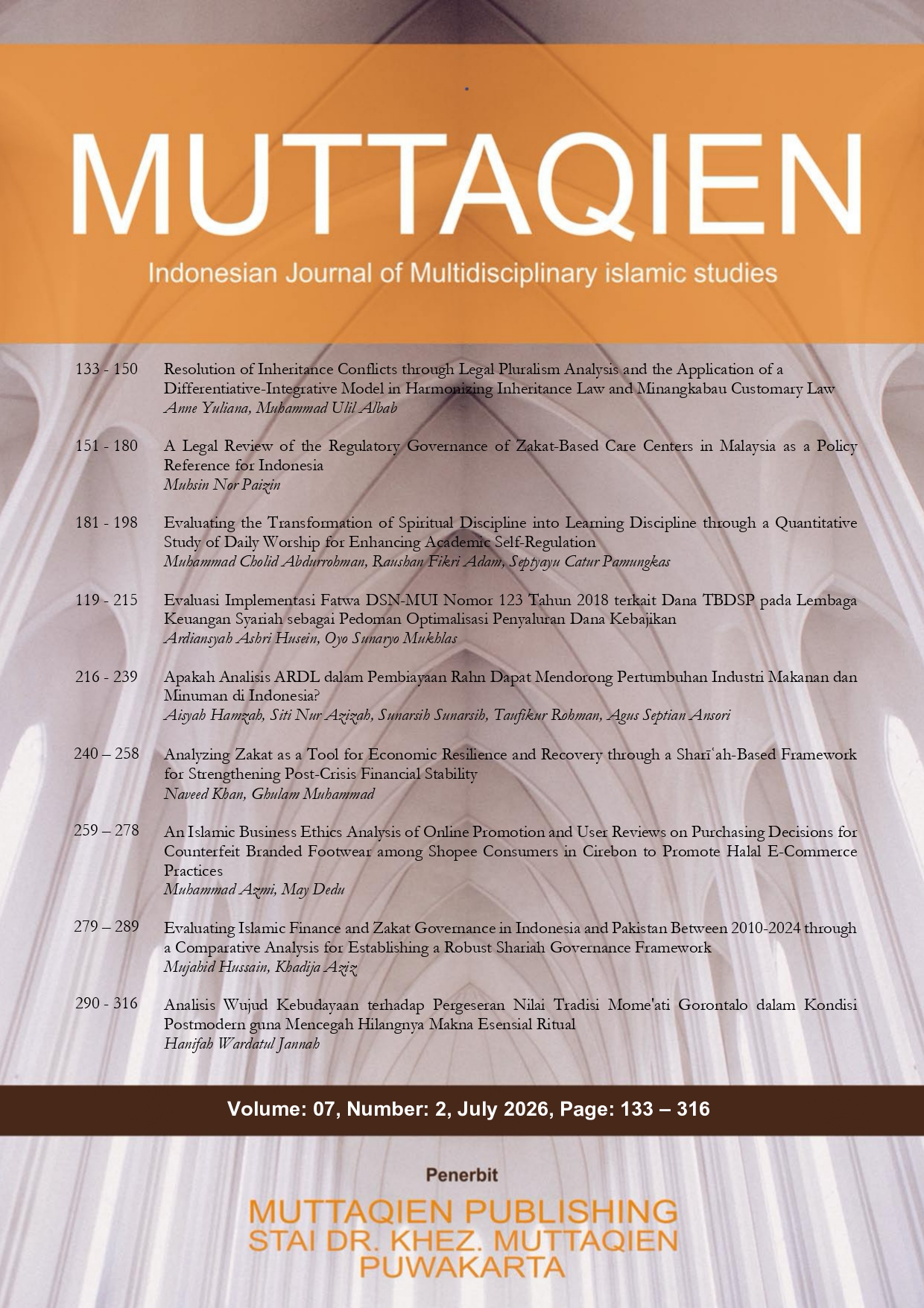
Analyzing Zakat as a Tool for Economic Resilience and Recovery through a Sharīʿah-Based Framework for Strengthening Post-Crisis Financial Stability
Keywords:
Zakat & Resilience,, Wealth Redistribution,, Sustainable Recovery,, Social Responsibility.Abstract
This study explores the role of Zakat as a strategic Islamic financial instrument in fostering socio-economic strengthening, supporting sustainable recovery, and promoting equitable wealth redistribution in the post-crisis era. Employing a qualitative analytical approach that integrates classical Islamic sources, contemporary research, and comparative evaluations, the study demonstrates that Zakat transcends the function of mere ritual worship. Zakat operates as a structured socio-economic system capable of proactively protecting vulnerable groups from economic shocks and social fragility. The findings indicate that integrating Zakat into national development strategies through transparent institutional governance can bolster financial stability, enhance workforce participation, and break the cycle of aid dependency by providing a dignified pathway out of poverty. While acknowledging limitations regarding empirical data availability and administrative variations across Muslim nations, the study offers practical implications by providing a robust Shari'ah-based framework for policymakers to optimize welfare governance. The originality of this research lies in its demonstration of the ethical, equitable, and sustainable dimensions of Zakat, qualities that distinguish it from conventional welfare models, while affirming its capacity as a cornerstone for building an inclusive, resilient socio-economic order capable of withstanding crises.References
Abdullah, M., & Abdulquddos, A. (2013). Spiritual and moral dimensions of Zakat. Jurnal Pengurusan, 31(2), 44–58.
Abdullah, M., & Abdul Quddus, A. (2011). Zakat compliance behavior among Muslims. International Journal of Business and Social Science, 2(11), 175–182.
Al-Kasani, A. (1986). Bada'i al-Sana'i fi Tartib al-Shara'i. Dar al-Kutub al-Ilmiyyah.
Al-Salih, M. (2020). Zakat and social welfare in contemporary Muslim societies. Journal of Muslim Minority Affairs, 40(3), 412–428.
Al-Shawkani, M. (1281 AH). Nayl al-Awtar. Dar al-Jil.
Beik, I. S., & Arsyianti, L. D. (2016). Construction of CIBEST model as measurement of poverty and welfare index from Islamic perspective. Al-Iqtishad: Journal of Islamic Economics, 7(1), 87–104.
Dhar, P. (2019). Zakat as a measure of social protection in Muslim communities. International Journal of Zakat, 4(1), 1–14.
Farah, A., Hassan, R., & Omar, M. (2012). Social impact of Zakat distribution in Muslim communities. Journal of Islamic Social Sciences, 5(1), 33–47.
Fu'adah, L., Mukhtaruddin, M., & Yuniarti, R. (2013). The effects of Zakat on poverty alleviation. Journal of Economics and Sustainable Development, 4(6), 29–35.
Hairunnizam, W., & Radiah, A. K. (2010). Localization of Malaysian Zakat distribution. Jurnal Pengurusan, 30, 101–115.
Hassan, M. K. (2010). An integrated poverty alleviation model combining Zakat, awqaf and micro-finance. In Proceedings of the Seventh International Conference The Tawhidi Epistemology: Zakat and Waqf Economy (pp. 261–281). Universiti Kebangsaan Malaysia.
Ibn al-Qayyim, M. (1994). Madarij al-Salikin. Dar al-Kitab al-Arabi.
Ibn Rajab, A. (1996). Jami' al-'Ulum wa al-Hikam. Mu'assasat al-Risalah.
Johari, F., Ali, A. F. M., & Ab Aziz, M. R. (2015). Zakat distribution and programme for sustaining convert Muslims. Jurnal Ekonomi Malaysia, 49(2), 109–118.
Kahf, M. (1989). Zakat: Unresolved issues in the contemporary fiqh. Journal of Islamic Economics, 2(1), 1–22.
Kusuma, D. B. W., & Sukmana, R. (2010). The power of Zakat in poverty alleviation. In Proceedings of the Seventh International Conference on Islamic Economics and Finance (pp. 1–18). Islamic Economics and Finance Research Alliance.
Muhammad, M., Saad, R. A. J., & Ibrahim, M. A. (2013). Zakat institution in Malaysia: Problems and issues. World Applied Sciences Journal, 28, 28–36.
Patmawati, I. (2006). Economic role of Zakat in reducing income inequality and poverty in Malaysia. Universiti Putra Malaysia Press.
Patmawati, I. (2008). Roles of Zakat in reducing poverty and income inequality. Journal of Islamic Economics, Banking and Finance, 4(2), 61–82.
Qaradawi, Y. (2006). Fiqh al-Zakat: A comparative study. Dar al-Taqwa.
Riaz, M. (2007). Zakat as a tool for poverty reduction. Journal of Muslim Minority Affairs, 27(2), 299–310.
Shirazi, N. S., & Amin, M. F. (2009). Poverty elimination through potential Zakat collection in OIC member countries. Pakistan Development Review, 48(4), 739–754.
Published
How to Cite
Issue
Section
Copyright (c) 2026 Naveed Khan, Ghulam Muhammad

This work is licensed under a Creative Commons Attribution-ShareAlike 4.0 International License.
Muttaqien; Indonesian Journal of Multidiciplinary Islamic Studies allows the author(s) to hold the copyright without restrictions and allows the author(s) to retain publishing rights without restrictions, and authors who publish with this journal agree to the following terms:
In developing strategy and setting priorities, Muttaqien; Indonesian Journal of Multidiciplinary Islamic Studies recognize that free access is better than priced access, libre access is better than free access, and libre under CC-BY-SA or the equivalent is better than libre under more restrictive open licenses. We should achieve what we can when we can. We should not delay achieving free in order to achieve libre, and we should not stop with free when we can achieve libre.
Muttaqien; Indonesian Journal of Multidiciplinary Islamic Studies has a CC-BY SA license or its equivalent as the optimal license for publication, distribution, use and reuse of scientific work. This license is under a Creative Commons Attribution 4.0 International License.

You are free to:
- Share copy and redistribute the material in any medium or format
- Adapt remix, transform, and build upon the material for any purpose, even commercially.
- The licensor cannot revoke these freedoms as long as you follow the license terms.