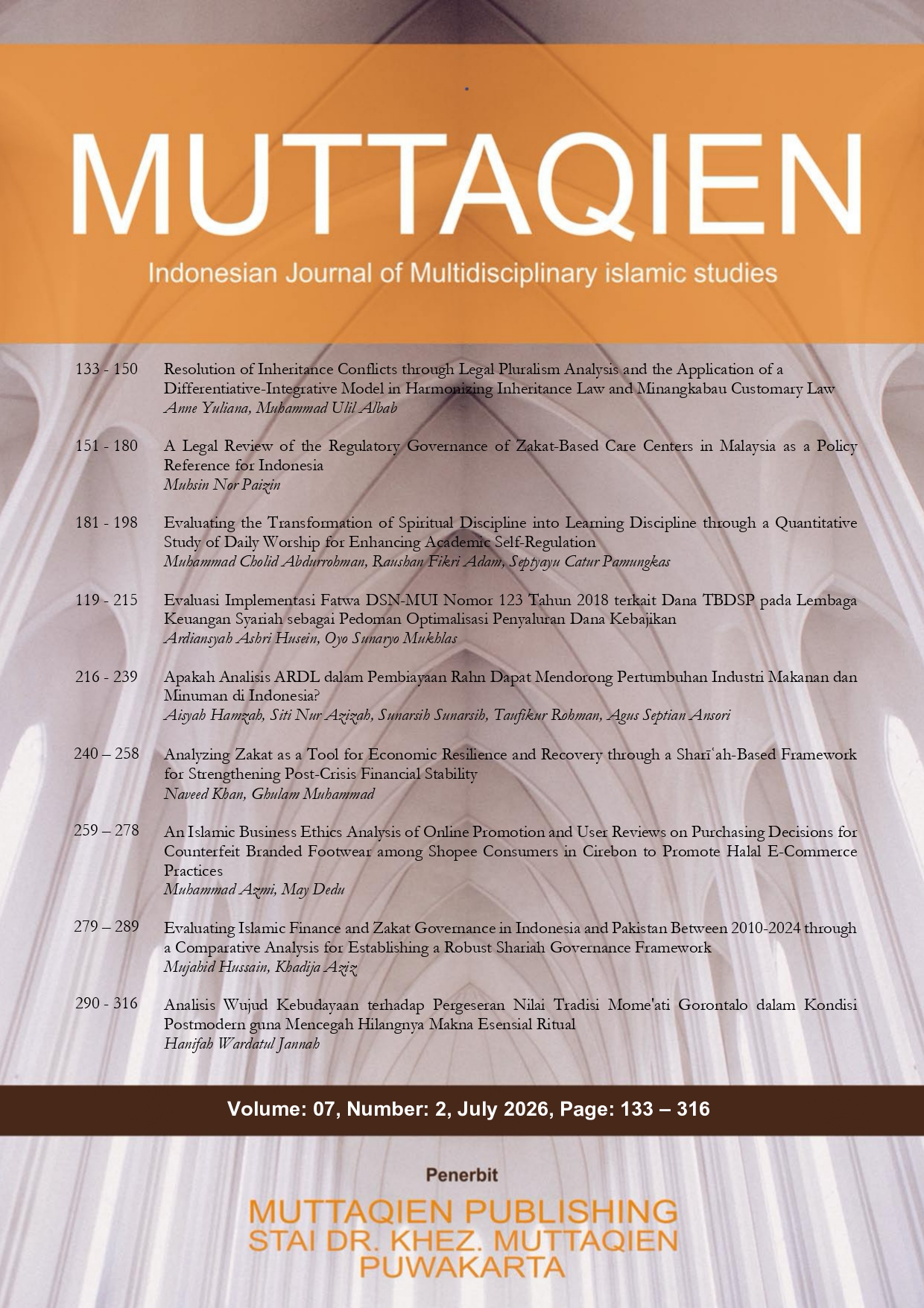
Analisis Wujud Kebudayaan terhadap Pergeseran Nilai Tradisi Mome'ati Gorontalo dalam Kondisi Postmodern guna Mencegah Hilangnya Makna Esensial Ritual
Keywords:
Islam Nusantara, Mome’ati, Cultural Forms, ntergenerational Value Transmission, Moral-Religious EducationAbstract
The Mome’ati tradition is a customary initiation ritual for adolescent Muslim girls in Gorontalo marking the transition to puberty. At the same time, as an institutionally preserved practice, this preservation tends to emphasize ceremonial aspects, thereby risking the loss of its original function as an institution for moral-religious education. This study aims to analyze the extent and mechanisms by which the values and meanings within the Mome’ati tradition have shifted amidst contemporary social conditions. Employing a qualitative method with a literature review design covering the period from 2012 to 2026, the study utilizes qualitative content analysis and hermeneutic-interpretative reading. Koentjaraningrat’s framework of cultural manifestations serves as the primary analytical lens, complemented by three theses regarding postmodern conditions: The Postmodern Condition (Lyotard), The Transformation of Intimacy (Giddens), and Liquid Modernity (Bauman), applied here as conceptual propositions derived deductively from theory rather than as field findings. The study proposes a thesis of internal tradition disintegration: while the artifactual and activity-based forms of Mome’ati remain well-preserved, the system of ideas risks erosion through five mechanisms, namely, the relativization of sacred values, the ceremonialization of custom, intergenerational fragmentation of meaning, cultural commodification, and the weakening of the transmitter's authority. Practically, the study recommends that the Gorontalo Provincial Government, through the Culture and Tourism Office, mandate value-orientation sessions before the procession and implement tools to evaluate participant understanding during mass Mome’ati events, and that customary institutions develop standardized teaching guidelines for traditional leaders. This thesis remains open to validation through further ethnographic research.References
Arifin. (2018). Nilai-nilai pendidikan Islam yang terkandung dalam tradisi mome’ati suku Gorontalo di Desa Pusungi Kecamatan Ampana Tete Kabupaten Tojo Una-Una [Skripsi, Institut Agama Islam Negeri Palu]. Repositori UIN Datokarama Palu. https://repository.uindatokarama.ac.id/id/eprint/196/
Auda, J. (2008). Maqasid al-Shariah as philosophy of Islamic law: A systems approach. International Institute of Islamic Thought.
Baharun, H., Ulum, M. B., & Azhari, A. N. (2018). Nilai-nilai pendidikan Islam dalam tradisi Ngejot: Konsep edukasi dalam membangun keharmonisan dan kerukunan antarumat beragama berbasis kearifan lokal. Fenomena, 10(1), 1–26.
Bakry, M. (2016). Nilai-nilai religiusitas adat mome’ati pada masyarakat Kota Gorontalo (replika Islam Nusantara). Al-Ulum, 16(1), 185–207.
Bauman, Z. (2000). Liquid modernity. Polity Press.
Bauman, Z. (2003). Liquid love: On the frailty of human bonds. Polity Press.
Bruinessen, M. van (Ed.). (2013). Contemporary developments in Indonesian Islam: Explaining the “conservative turn”. Institute of Southeast Asian Studies.
Dinas Pemberdayaan Perempuan dan Perlindungan Anak Provinsi Gorontalo. (2025a, 26 Mei). Antara hukum dan kenyataan: Regulasi perkawinan anak belum jadi tameng di Gorontalo. https://pppa.gorontaloprov.go.id/antara-hukum-dan-kenyataan-regulasi-perkawinan-anak-belum-jadi-tameng-di-gorontalo
Dinas Pemberdayaan Perempuan dan Perlindungan Anak Provinsi Gorontalo. (2025b). Laporan akuntabilitas kinerja instansi pemerintah (LAKIP) tahun 2024. https://pppa.gorontaloprov.go.id/uploads/PDF20250625060732.pdf
Geertz, C. (1960). The religion of Java. University of Chicago Press.
Giddens, A. (1992). The transformation of intimacy: Sexuality, love and eroticism in modern societies. Polity Press.
Halid, E., & Novianti, H. (2017). Tahap awal menjelang pelaksanaan prosesi Mome’ati masyarakat Gorontalo. Puitika, 13(2). [Lengkapi nomor halaman dan DOI bila tersedia.]
Karim, H. B., & Samsudin, T. (2020). Peran perempuan dalam adat istiadat Gorontalo. As-Syams: Journal Hukum Islam, 1(2), 69–93. [Lengkapi DOI bila tersedia.]
Kementerian Pemberdayaan Perempuan dan Perlindungan Anak. (2023, 25 Maret). Wujudkan pemenuhan hak anak, Kemen PPPA dukung Provinsi Gorontalo cegah perkawinan anak. https://kemenpppa.go.id/berita-pemerintahan/wujudkan-pemenuhan-hak-anak-kemen-pppa-dukung-provinsi-gorontalo-cegah-perkawinan-anak
Koentjaraningrat. (1985). Pengantar ilmu antropologi. Aksara Baru.
Kompas.com. (2024, 22 Juli). 276 anak Gorontalo ikuti tradisi momeati dan moluna, janji kesucian diri dan kedewasaan. https://makassar.kompas.com/read/2024/07/22/113825678/276-anak-gorontalo-ikuti-tradisi-momeati-dan-moluna-janji-kesucian-diri-dan
Lyotard, J.-F. (1984). The postmodern condition: A report on knowledge (G. Bennington & B. Massumi, Terj.). University of Minnesota Press. (Karya asli terbit 1979)
Mashadi. (2012). Realitas adati hula-hulaa to Syara’i, Syara’i hula-hulaa to Qur’ani. Al-Ulum, 12(1), 201–222.
Mokoginta, S. (2022). Perspektif Islam tentang tradisi lokal dalam proses pelaksanaan upacara beati di Gorontalo. Jurnal PAI: Jurnal Kajian Pendidikan Agama Islam, 1(2), 137–145. https://doi.org/10.33507/pai.v1i2.630
Pala, N. A., Syamsuddin, S., Fadillah, F., Yunidar, Y., & Nirmayanti, N. (2026). Makna simbolik ritual Momeati melestarikan identitas budaya Gorontalo. Academia Open, 11(2). https://doi.org/10.21070/acopen.11.2026.14833
Paluseri, D. D., Putra, S. A., Hutama, H. S., Hidayat, M., & Putri, R. A. (2018). Penetapan warisan budaya takbenda Indonesia tahun 2018. Direktorat Warisan dan Diplomasi Budaya, Kementerian Pendidikan dan Kebudayaan.
Pebrianto, R., Saputra, H., & Bakhtiar, N. (2019). Kearifan lokal dalam tradisi Mandi Balimau Kasai: Peran pemangku adat untuk menjaga nilai-nilai Islam di Desa Alam Panjang, Kecamatan Rumbio Jaya, Kabupaten Kampar, Provinsi Riau. JUSPI: Jurnal Sejarah Peradaban Islam, 3(1), 17–24.
Pemerintah Provinsi Gorontalo. (2025a, 16 Mei). Gorontalo catat 1.257 kasus ODHA, Wagub ajak masyarakat hentikan stigma. Portal Resmi Pemerintah Provinsi Gorontalo. https://berita.gorontaloprov.go.id/2025/05/16/gorontalo-catat-1-257-kasus-odha-wagub-ajak-masyarakat-hentikan-stigma/
Pemerintah Provinsi Gorontalo. (2025b, 29 Juli). Wagub ajak ASN lawan stigma ODHA dan dukung “Three Zeros”. Portal Resmi Pemerintah Provinsi Gorontalo. https://berita.gorontaloprov.go.id/2025/07/29/wagub-ajak-asn-lawan-stigma-odha-dan-dukung-three-zeros/
Rahmaniar, F. S., Suyitno, S., Supana, S., & Saddhono, K. (2020). Keselarasan kearifan lokal dengan nilai keislaman pada tradisi Labuhan Gunung Kombang di Kabupaten Malang. Jurnal SMART: Studi Masyarakat, Religi, dan Tradisi, 6(1), 113–125.
Sjadzali, M. (1997). Ijtihad kemanusiaan. Paramadina.
Woodward, M. (2011). Java, Indonesia and Islam. Springer.
Published
How to Cite
Issue
Section
Copyright (c) 2026 Hanifah Wardatul Jannah Dilo

This work is licensed under a Creative Commons Attribution-ShareAlike 4.0 International License.
Muttaqien; Indonesian Journal of Multidiciplinary Islamic Studies allows the author(s) to hold the copyright without restrictions and allows the author(s) to retain publishing rights without restrictions, and authors who publish with this journal agree to the following terms:
In developing strategy and setting priorities, Muttaqien; Indonesian Journal of Multidiciplinary Islamic Studies recognize that free access is better than priced access, libre access is better than free access, and libre under CC-BY-SA or the equivalent is better than libre under more restrictive open licenses. We should achieve what we can when we can. We should not delay achieving free in order to achieve libre, and we should not stop with free when we can achieve libre.
Muttaqien; Indonesian Journal of Multidiciplinary Islamic Studies has a CC-BY SA license or its equivalent as the optimal license for publication, distribution, use and reuse of scientific work. This license is under a Creative Commons Attribution 4.0 International License.

You are free to:
- Share copy and redistribute the material in any medium or format
- Adapt remix, transform, and build upon the material for any purpose, even commercially.
- The licensor cannot revoke these freedoms as long as you follow the license terms.